
Families rarely miss a plan because nobody cared. More often, a chore, errand, or time-bound commitment gets buried in a message thread—or stays in one person’s head until the wrong moment.
That is why people looking for a shared family calendar app are often looking for more than a place to write down dates. They need a shared view of what is planned, who is responsible, and what deserves attention next. A notification can help, but only when it leads back to enough context to act.
A reminder should point to a plan, not become the plan
Notification research offers a useful caution. A 2024 education study of smartphone reminders found that reminders can support action on the days they appear, while also raising the risk of overreliance when people no longer use their own planning habits without them. That study involved students aged 10–12, not adult family coordination, so it cannot tell us what will happen in a household. Still, the underlying distinction is practical: a cue is most useful when the plan remains understandable without the cue.
For a family, that plan might be a task with a start time and notes, an event with a defined time window, or a shopping list assigned to the person handling an errand. The durable object is the shared plan; the notification is simply a possible route back to it.
This is also why a shared task list can be more useful than a vague “Don’t forget” message. The person receiving the cue can open the item and see what the task is, when it is planned, and who is involved instead of reconstructing the request from a chat history.
Why shared context matters for assigned work
Research on collaborative task reminders in workplace email points to a related problem: commitments are easy to lose in lightweight communication, and people do not all agree on what a reminder should capture or how they should act on it. This is analogous evidence—not research about families or Shareday—but it helps explain why assignment and context matter.
In everyday family coordination, a useful plan answers a few basic questions:
- What needs to happen?
- When is it planned?
- Who is responsible?
- Where can the family return to the same details?
That is the value proposition behind a family task management app: not a stream of alerts, but a shared place where responsibilities can remain visible. In Shareday, the Family Calendar displays planned Tasks, Events, and Shopping Lists by day and time, and family members can open those planned items from the calendar.
For example, instead of sending “Can you pick up groceries later?” as a standalone message, a family can create a Shopping List, add the needed items, and assign it. The plan is there for the family to revisit; the shopping list can also be opened from its calendar context. A family to do list becomes clearer when responsibility and timing do not have to live in separate conversations.
Keep the cue actionable and the plan easy to find
Design-oriented notification work has explored how format, perceived importance, and overload can shape engagement. It is design-supporting context rather than proof of a specific outcome. The practical lesson for family planning is modest: avoid treating every nudge as equally meaningful, and make the next action obvious.
An expert explainer on alert fatigue makes a similar point from enterprise, security, and healthcare contexts: low-value or non-actionable alerts can cause people to tune out. That is expert opinion, not family-app research. But it reinforces a sensible editorial principle for household planning: a cue earns attention when it leads to something concrete.
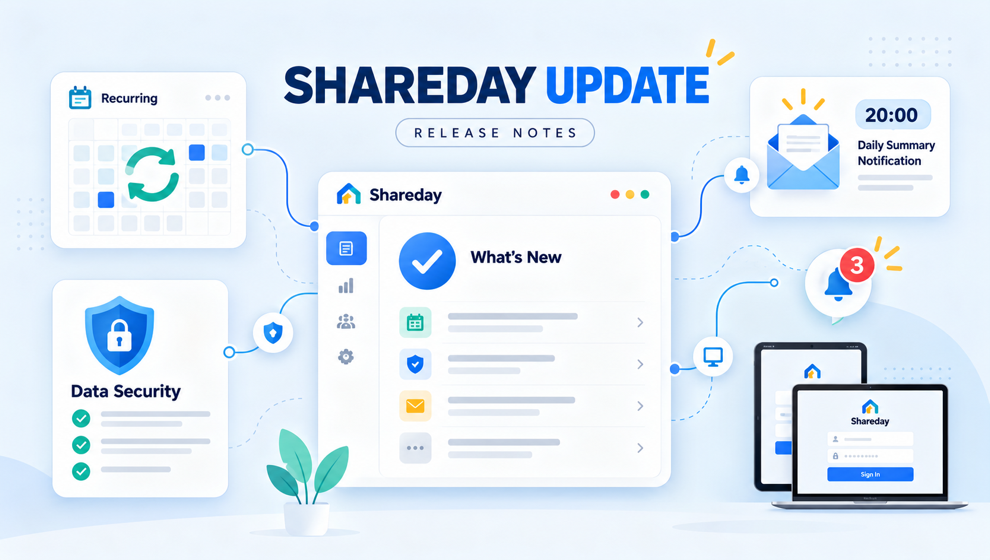
In Shareday, newly assigned adult family members can receive push/email delivery attempts for planned items where notification delivery is available and configured. Shareday also supports push-token registration for app devices and can route notifications into planned items where supported. Those behaviors should be understood as attempts and pathways—not a guarantee that a message arrives, is seen, or results in completion.
The useful follow-through is the planned item itself. A recipient may be routed into a task, event, or shopping list and use the shared details to decide what to do next. If a plan needs discussion or changes, the notification should not be expected to replace that conversation.
A practical way to set up an assigned family plan
When a responsibility is time-sensitive, keep the setup simple:
- Create a Task, Event, or Shopping List with a clear title.
- Add the available time details and notes that explain the work.
- Assign the relevant adult family member or members.
- Keep the item visible on the Family Calendar so the plan has a shared home.
- Where notification delivery is available and configured, treat any delivery attempt as a prompt to open the assigned plan—not as confirmation that the work is done.
This approach gives the family two useful layers: a clear shared record and, where supported, a cue that can bring an assignee back to it.
Is Shareday a family reminder app?
People searching for a family reminder app are usually trying to solve a real coordination problem: important responsibilities should not disappear between conversations. For Shareday, that phrase is best understood as the problem being explored, not as a promise of a standalone reminder or alarm service.
Shareday’s documented notification behavior is tied to family planning: it can register push tokens, make push/email delivery attempts for newly assigned adult family members where configured, and route notifications into planned items where supported. The broader purpose is to keep a shared Task, Event, or Shopping List connected to the family’s planning space.
The right kind of reminder leaves the family with clarity
The goal is not to produce more alerts. It is to make the important plan easier to recover at the moment someone needs it.
For adult families coordinating chores, errands, and time-bound plans, a shared calendar item with an owner, timing, and details gives a reminder somewhere useful to lead. The notification may be the cue; the shared plan is what keeps the work understandable.