
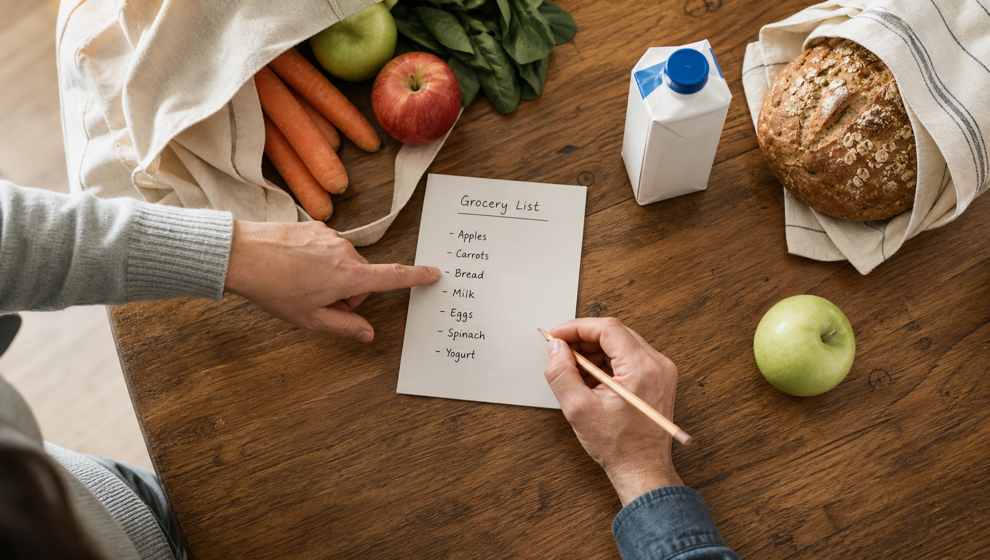
Shared Grocery Lists: What Research Suggests—and a Practical Shareday Workflow
A shared grocery list is often more useful when it carries a little context alongside the items: who is handling the errand, what still needs attention, and what has already been picked up. That does not require a complicated system. It does require the household to agree on where the list lives and how it is updated.
Research and practical guidance offer a helpful way to think about that small routine. The ideas below are not promises about any app or household. They are a starting point for turning an ordinary errand into a clearer shared plan.
A list can hold shared household knowledge
In a 2008 qualitative study of Canadian households, researchers Raewyn Bassett, Brenda Beagan, and Gwen E. Chapman described grocery lists as more than reminders. The lists reflected shared knowledge: what people in the home needed, what supplies were running low, and how shopping usually worked. That is a useful framing, even though the study is older and its observations are not universal.
For a family, the practical takeaway is modest: a list is easier to use when it is not trapped in one person’s memory or scattered across a message thread. A household shopping list can give everyone a common place to add an item before the person doing the errand leaves.
What extension guidance adds to the routine
University extension guidance offers similarly practical advice. The University of Minnesota recommends cooperative planning and keeping an ongoing shopping list. Utah State University Extension recommends making a list before shopping as part of weekly planning. Neither source tests Shareday or proves that a digital list changes purchasing behavior; both simply point to a repeatable planning habit.
That habit can be kept small:
- add items when the household notices a need;
- decide who will shop for the current errand;
- use the list while shopping; and
- update the item state as the errand moves along.
This is also where grocery list organization becomes less about finding the perfect format and more about making the next step obvious to the person who has the errand.
A realistic note: one list will not solve every coordination problem
In a 2025 The Verge opinion piece, Allison Johnson argues that grocery-list tools have to contend with many different household habits and planning tasks. It is a consumer-tech perspective, not research, but the point is worth keeping: a shared shopping list is not a cure-all for family coordination.
The useful goal is narrower. Put the items, the shopper’s responsibility, and the completed-item status in a place the family can return to. Each household can decide how much detail belongs there.
How to put the idea into practice in Shareday
Shareday’s documented Shopping List flow supports a straightforward version of this routine for a planned errand.
- Create the list for the errand. A family member can start a Shopping List from the Family Calendar or from the Shopping List creation flow. For a planned trip, the scenario includes setting the list for a specific date and time.
- Add the items that belong to this trip. Shopping Lists support multiple rows, so the household can collect the needed purchases in one list.
- Assign the shopper. The list can be assigned to a family member. For a family grocery list, this makes the errand’s owner visible in the list rather than leaving that detail implied in a conversation.
- Open the list during the errand. The assigned person can open it from the calendar or list context before or while shopping.
- Mark purchased items completed. As items are bought, the shopper can mark their rows as purchased/completed. Shareday documents that this completion state remains connected to the shared family item after sync/rehydrate.
The workflow does not depend on adding every household habit to Shareday. A family may still plan meals elsewhere, keep paper notes, or talk through changes in person. The focused use here is simply a list with multiple items, an assigned person, and a documented completion state.
A simple way to start
Try the next ordinary shopping errand as a short experiment in clarity:
- create one list for that errand;
- add only the items already known;
- assign the person who plans to shop; and
- mark rows as purchased as that person uses the list.
Afterward, keep only the parts that fit your household. The research and guidance point to the value of a shared planning habit; Shareday provides documented list, assignment, calendar, and completion-marking behavior for putting that habit into one family-planning context.
Frequently asked questions
What is the difference between a shared grocery list and a regular list?
The phrase usually means more than one household member can contribute to or rely on the same list. In this article, the practical distinction is that the list also identifies the person handling the errand and records purchased/completed rows.
Can a Shareday Shopping List be assigned to someone?
Yes. Shareday documents that a Shopping List can be assigned to no one, one person, multiple people, all relevant family members, or child profiles. This article’s example uses a single assigned shopper because that is the selected scenario.
Does Shareday automatically create a list from any calendar event or meal plan?
This article does not make that claim. Shareday documents recipe-linked Shopping Lists from recipe ingredients during recipe planning; it does not establish automatic list creation for arbitrary events or meal plans.